


A belt conveyor runs on several pulleys, and they are not interchangeable. Each one does a specific job, sits in a specific place, and is sized for a specific load.
The five you meet on almost every conveyor are the drive, the tail, the snub, the bend, and the take-up. From a distance they look like the same steel drum. What separates them is the job they do and the force they carry, and that is what decides which one you order.
Get the match right and the pulley lasts for years. Put a light bend pulley where the drive should be and it fails early, usually in the middle of a shift. Many pulleys that get replaced failed because they were sized for the wrong job, not because they wore out.
So the practical question is not what a pulley is. It is which one belongs at each point on your belt, and how big it has to be.
The drive pulley moves the belt. The tail pulley turns it around at the far end. The snub pulley adds belt wrap for traction. The bend pulley changes the belt's direction on the slack side. The take-up pulley moves to keep the belt in tension as it stretches. One drum, five different jobs.
A conveyor pulley is a steel drum the belt wraps around. Its job depends on where it sits in the belt path and how much of the belt wraps over it.
The cleanest way to sort them is by what they do, where they sit, and whether they are powered:
Pulley | Its job | Where it sits | Driven? | Lagged? |
|---|---|---|---|---|
Drive (head) | Moves the belt | Discharge end | Yes | Yes |
Tail | Turns the belt around | Loading end | No | No |
Snub | Adds wrap for traction | Beside the drive | No | No |
Bend | Changes belt direction | Return run | No | No |
Take-up | Holds tension | Return run, moving | No | No |
Only one of the five is powered. The drive pulley turns; the rest are turned by the belt. That single fact explains most of the differences between them, from diameter to lagging to shaft size, and it is the first thing to settle when you spec a replacement.
Beyond these five sit the specialty pulleys, the wing, magnetic, and spiral types, which solve narrower problems. If you are comparing options for a new conveyor or a replacement drum, this is the point to look at pulley duty, lagging, and diameter together before you lock the spec.
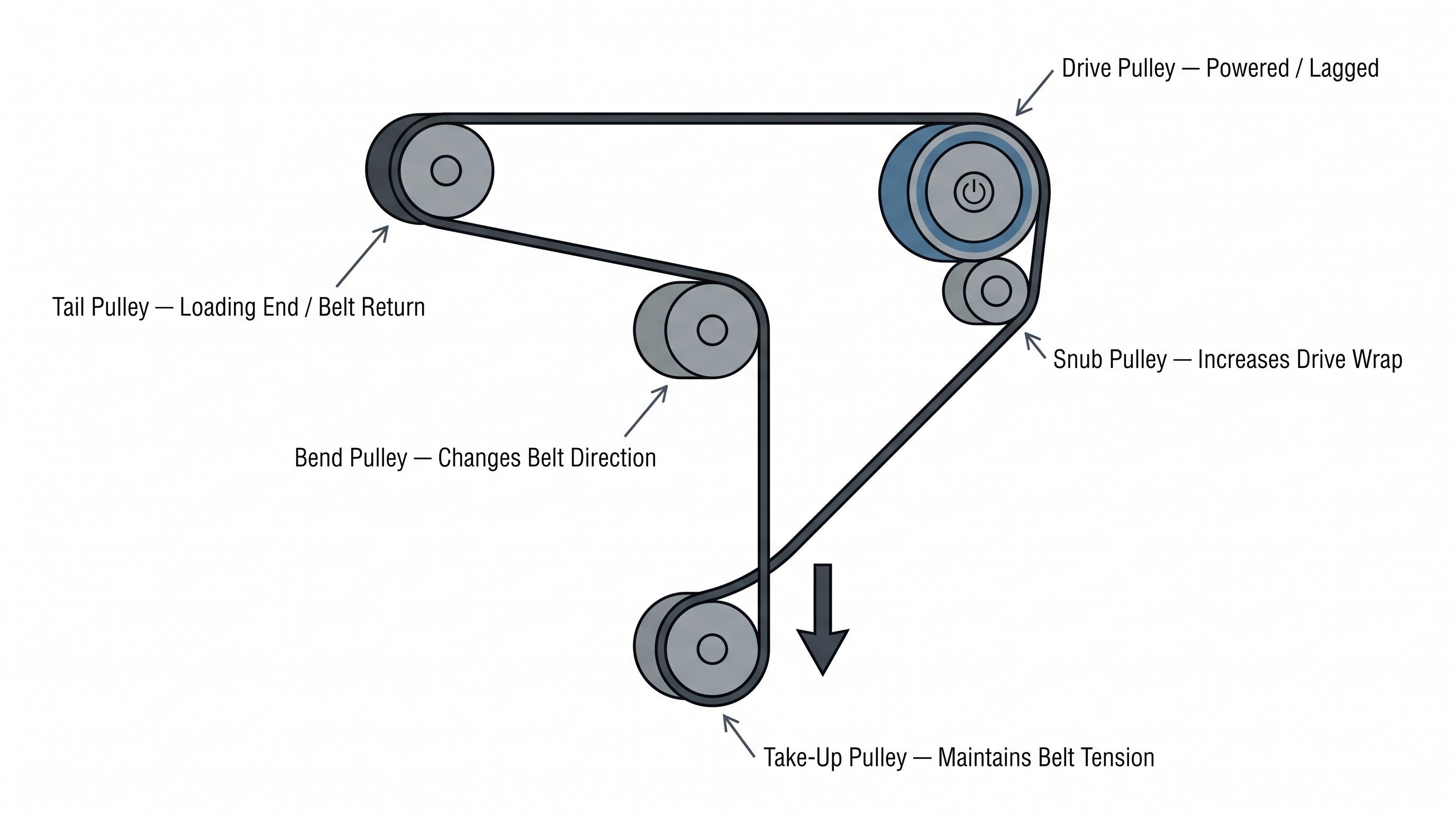
This is the pulley you cannot afford to under-spec. The drive pulley, usually at the discharge end and often called the head pulley, is connected to the motor and gearbox. It is what pulls the belt, and if it slips or fails, the conveyor stops.
It moves the belt by friction. The motor turns the pulley, and the grip between the pulley face and the belt drags the belt along. That grip is the whole game, and two things set it:
Wrap angle. How much of the belt hugs the pulley. A belt over a single drive pulley wraps about 180 degrees. More wrap means more grip before the belt slips.
The pulley face. A drive pulley is almost always lagged, meaning covered in a rubber or ceramic surface that grips better than bare steel.
The drive pulley is also the largest and heaviest of the set, because it carries the belt tension and the drive torque together. That is why it takes the thickest shaft and the most robust bearings.
The tail pulley sits at the loading end and turns the belt around to send it back down the return side. Spec it like a drive pulley and you have overpaid. Spec it too light and it is the one that gives you tracking trouble.
Its defining problem is not power. It is impact and buildup. Material is usually loaded onto the belt at or near the tail, so the pulley sees the shock of falling material and the fines that work their way to the belt underside. Sticky material packs onto a smooth tail pulley and throws the belt off track.
This is why the tail is where you often see a wing pulley instead of a plain drum. The open, vaned shape lets material fall through instead of packing on the face. More on that below.
The tail pulley is not lagged as a rule, because it is not driving anything. It just needs to turn cleanly and shed material.
Here is the one that gets confused with the bend pulley, so it is worth being precise.
A snub pulley has one job. It presses against the belt near the drive pulley to increase the wrap angle on the drive. Nothing else. It does not redirect the conveyor, it does not carry load, and it does not change where the belt goes.
The reason it exists is traction. If a single drive pulley cannot grip hard enough at 180 degrees of wrap, a snub pulley bends the belt in tighter, raising the wrap to 210 degrees or more. That extra contact lets the drive move a heavier belt without slipping, and without paying for a larger drive pulley or a dual-drive arrangement.
This shows up in retrofit work as well. Where a drive slips, the cause is often too little wrap rather than the drive pulley itself, and adding wrap at the drive can settle the conveyor down without a wholesale change to the drive assembly.
A snub pulley is small, unlagged, and sits just off the drive on the return side. If you see a little pulley tucked next to the big driven one, that is a snub.
Now the pulley the snub gets mistaken for. A bend pulley also pushes against the belt, but for a different reason. Its job is to change the belt's direction of travel.
You find bend pulleys in the return run, guiding the belt around the take-up or routing it past structure. They work on the slack side, where belt tension is low, so they carry far less load than a drive or a tail.
The difference from a snub is the intent. A snub increases wrap on the drive to build traction. A bend redirects the belt through a corner of its path. They can look identical on the floor, but one is there for grip and the other is there for routing.
Because they run on the low-tension side, bend pulleys are usually the lightest in the set. They are unlagged and sized for direction change, not for driving.
Every other pulley so far has been fixed in place. This one moves, and that movement is its purpose.
A belt stretches. It stretches as it breaks in, it stretches under load, and it lengthens and shortens with temperature. If tension is not held steady, a slack belt slips at the drive and sags between the idlers. The take-up pulley is what keeps the tension constant.
It does this by moving to take up the slack. Two arrangements are common:
Gravity take-up. A weighted pulley hangs on the return run. The weight pulls the belt taut and adjusts on its own as the belt stretches.
Screw take-up. A jack or screw at the tail is set by hand. Simpler and cheaper, and used on shorter conveyors where belt stretch is small.
A take-up pulley is frequently also a bend pulley, because the belt bends around it as it hangs or slides. That overlap is normal, and it is a good example of a single pulley filling two roles at once.
Which take-up you choose is a real cost decision. A gravity take-up costs more to build and needs the vertical room for the weight, but it holds tension without anyone touching it. A screw take-up is cheaper and simpler, but someone has to reset it as the belt stretches. Short conveyor, screw take-up. Long or high-tension conveyor, gravity.
The five core pulleys handle the belt path. Three more solve specific material problems, and they show up where the duty calls for them.
Type | What it solves |
|---|---|
Wing pulley | Vaned, open shape lets sticky material fall through instead of packing on the face. Common at the tail. |
Magnetic pulley | A magnetized drive pulley that pulls tramp metal out of the material stream, usually ahead of a crusher. |
Spiral pulley | A spiral-vaned face that sheds wet and sticky buildup while still driving or turning the belt. |
These are not alternatives to the core five. A wing pulley is still doing a tail pulley's job. A magnetic pulley is still a drive pulley, with metal separation added. They are the core types adapted to a harder material.
Which pulleys a conveyor needs, and in what diameter, comes down to belt tension and material. The spec sheet lays out our diameter, lagging, and shaft options against belt tension, which is a quick way to check a design while you are still laying it out.
Two numbers decide most of a pulley's design: diameter and wrap angle. Neither is guesswork, and both trace back to the belt and a published standard.
Diameter comes from belt tension and belt construction. A pulley that is too small over-flexes the belt every revolution, which cracks the cover and fatigues the carcass. Higher tension and heavier belts need larger pulleys. Our conveyor pulleys run from about 8 inches on light conveyors up to 48 inches and beyond for high-tension mining duty. The current standard, ANSI/CEMA B105.1, sets the load ratings, standard diameters, and shaft dimensions for welded steel pulleys.
Wrap angle decides drive traction, as covered above. A single drive gets about 180 degrees. A snub raises it to 210 degrees or more. A dual-drive arrangement can wrap two pulleys for a combined 400 degrees and above on the heaviest belts.
Standards sort pulleys into three duty groups by how hard they work, and the minimum diameter climbs with the group:
Group | Pulleys | Belt tension | Diameter |
|---|---|---|---|
Group A | Drive | Highest | Largest |
Group B | Bend, take-up | Lower | Medium |
Group C | Snub | Low, about 30° wrap | Smallest |
This is why a drive and a snub on the same conveyor are not the same size. The drive carries full belt tension plus drive torque, so it sits in Group A and takes the largest diameter. The snub only bends the slack belt about 30 degrees, so it lands in Group C and can be smaller.
Two more dimensions follow the belt:
Face width. The pulley face is made a couple of inches wider than the belt, so the belt can wander without running off the edge of the drum. A 36-inch belt runs on a face around 38 to 39 inches.
Crown. Pulley faces are slightly larger in diameter at the center than at the edges. That gentle taper helps the belt center itself and stay tracked. A small feature that quietly prevents a lot of tracking trouble.
Shaft and bearings follow the load. Standard shafts use AISI 1045 carbon steel, while high-torque drives move up to 4140 or 4340 alloy steel. Sealed, self-aligning bearings in pillow-block housings handle the misalignment and dust of a plant conveyor.
The number that most often gets a pulley wrong is minimum diameter. Wrap the belt around a drum that is too small, and the belt fails before the pulley does.
The minimum comes from the belt, not the pulley. A belt has a carcass, either fabric plies or steel cords, and bending it tighter than it is built for cracks the cover and fatigues that carcass. The heavier the belt rating, the larger the smallest drum it can run on.
Three things worth holding on to:
Steel-cord belts need pulleys up to 50 percent larger than fabric belts of the same width. The steel cords do not tolerate a tight bend.
Each duty group gets its own minimum. For the same belt, a drive pulley needs the largest diameter and a snub the smallest, following the A, B, and C groups above.
ISO 3684 and DIN 22101 are the references that return minimum drive, bend, and snub diameters from the belt's tension class. US plants running imported belts see both cited on belt datasheets.
Belt suppliers publish a minimum pulley diameter for every belt they sell. That number is the one to design to. It is cheaper to read it off the belt datasheet than to find it out after the cover starts cracking.
Replacement pulleys are often matched to the old drum because the structure is already fixed and shutdown time is tight. That shortcut can backfire when the belt spec has changed. If a belt moves to a heavier construction but keeps the old pulley diameter, belt distress can show up soon after startup, and the fix is to increase pulley diameter rather than replace another shell.
The five types are jobs, not always five separate parts. The same drum can wear more than one hat.
A head pulley is a drive pulley. A gravity take-up pulley is also a bend pulley. A tail pulley on sticky material is often a wing pulley. The label describes the job the pulley is doing at that point in the belt path, not a fixed catalog part.
That is the useful way to read a conveyor. Ask what each pulley is doing, where it sits, and how much belt wraps it. The answer tells you the diameter, whether it needs lagging, and how big the shaft has to be.
If you are laying out a conveyor or replacing pulleys on an existing one, our engineers can work out the pulley set the belt needs, the drive diameter for your tension, and where lagging earns its cost. That is a faster path than matching a worn part by eye and hoping the replacement holds.
A conveyor runs on five core pulleys: drive, tail, snub, bend, and take-up. Only the drive is powered.
The drive pulley moves the belt by friction, so it is lagged, largest, and depends on wrap angle for grip.
A snub pulley adds wrap to the drive for traction. A bend pulley just changes the belt's direction. That is the difference.
The take-up pulley moves to hold tension as the belt stretches, by gravity weight or by a screw.
Minimum diameter comes from the belt, not the pulley. Steel-cord belts need drums up to 50 percent larger than fabric belts, per ISO 3684 and ANSI/CEMA B105.1.
Standards group pulleys by duty: Group A drive, Group B bend and take-up, Group C snub. One drum can fill more than one of these roles at once.
The five core types are the drive pulley, which moves the belt, the tail pulley, which turns it around at the loading end, the snub pulley, which adds belt wrap for traction, the bend pulley, which changes the belt's direction, and the take-up pulley, which holds tension as the belt stretches. Specialty types include wing, magnetic, and spiral pulleys for sticky material and tramp metal removal.
The head pulley sits at the discharge end and is usually the drive pulley, connected to the motor and lagged for grip. The tail pulley sits at the loading end and turns the belt around for its return run. The head pulley transmits power; the tail pulley takes the loading impact and the material buildup. The head is larger and heavier because it carries drive torque as well as belt tension.
A snub pulley increases the wrap angle on the drive pulley. It presses against the belt near the drive so that more of the belt hugs the drive pulley, raising traction from about 180 degrees of wrap to 210 or more. That lets the drive move a heavier belt without slipping, and without needing a larger drive pulley. It does not redirect the conveyor or carry significant load.
They look similar but do different jobs. A snub pulley increases belt wrap on the drive pulley to build traction. A bend pulley changes the belt's direction of travel, usually in the low-tension return run around the take-up. A snub is about grip; a bend is about routing. Both press against the belt, which is why they get confused.
A take-up pulley keeps the belt in constant tension as it stretches under load and temperature. It moves to take up slack, either as a gravity take-up with a hanging weight on the return run, or as a screw take-up set by hand at the tail. Without it, a stretched belt slips at the drive and sags between the idlers.
The drive pulley is almost always lagged, because lagging improves the grip it needs to move the belt by friction. The other pulleys are usually bare steel, since they are turned by the belt rather than driving it. On wet or high-tension drives, ceramic lagging is used for maximum grip, while rubber lagging covers standard duty.
Diameter comes from belt tension and belt construction. A pulley too small for the belt over-flexes the cover and carcass every revolution, which shortens belt life. ANSI/CEMA B105.1 sets the standard diameters, load ratings, and shaft dimensions for welded steel pulleys, which run from about 8 inches on light conveyors to 48 inches and beyond on heavy-duty mining belts. The face is made a couple of inches wider than the belt so it can wander without running off the drum.
The minimum comes from the belt, not the pulley. Bending a belt tighter than its carcass allows cracks the cover and fatigues the plies or cords. Steel-cord belts need pulleys up to 50 percent larger than fabric belts of the same width, because the cords do not tolerate tight bends. ISO 3684 and DIN 22101 return the minimum drive, bend, and snub diameters from the belt's tension class, and belt suppliers publish a minimum diameter for every belt they sell.

Delivering advanced conveyor solutions from Houston across the U.S.


