

In a bulk conveyor, the wrong idler class costs money either way you miss it. Idlers all look about the same on a drawing, so it is easy to pick a class off the belt width and move on. In practice, belt width is not what sets the class.
The class is set by the load the idler actually carries. Choose a class higher than you need and you pay for roll and bearing steel that never gets used, on hundreds of idlers down the run. Choose one lower than you need and bearing life falls early. In idlers plants send out for replacement, that mismatch usually shows up in the bearing before anything looks badly wrong from a distance.
Let us keep this simple. Here is how to find the CEMA idler class you actually need, so you get the service life you are paying for without overspending on the whole conveyor.
CEMA rates conveyor idlers in five duty classes, B through F, light to heavy. The class comes from the load the idler carries, which is the weight of the belt plus the material sitting on one idler spacing, checked against belt speed for bearing life. Each class up means a bigger roll, a larger bearing, and a higher load rating. Size to the load your belt puts on the roll, add impact rating only at the load zone, and confirm the numbers against CEMA 502.
CEMA, the Conveyor Equipment Manufacturers Association, sorts idlers into duty classes. Each step up grows the roll diameter, the shaft, and the bearing, so it carries more load and handles higher belt speeds.
Class | Duty | Roll diameter | Typical belt width | Where it fits |
|---|---|---|---|---|
B | Light | 4 to 5 in. | 18 to 36 in. | Low tonnage, fine material, short runs |
C | Medium | 4 to 6 in. | 18 to 42 in. | General plant duty, the common default |
D | Heavy | 5 to 7 in. | 24 to 60 in. | Higher tonnage, abrasive material |
E | Extra heavy | 6 to 8 in. | 36 to 72 in. | High tonnage aggregate and mining |
F | Very heavy | 8 in. and up | 42 to 96 in. | Large mine and overland belts |
Read the belt width column as a starting point, not the answer. Two belts of the same width can need different classes if one carries heavier material, runs faster, or has its idlers spaced farther apart. The exact roll, shaft, and bearing sizes for each class are set out in CEMA 502, the US standard for bulk conveyor troughing and return idlers.
Add the weight of the belt and the weight of the material sitting on one idler spacing, then compare that load to the class rating at your belt speed. For example, a 48 in. belt carrying crushed limestone at about 90 lb/ft³ on 4 ft spacing loads an idler very differently from the same 48 in. belt carrying dry fly ash at about 40 lb/ft³ on 3 ft spacing. CEMA 502 is where that load and speed check belongs. Four things drive the number, and belt width by itself is not one of them.
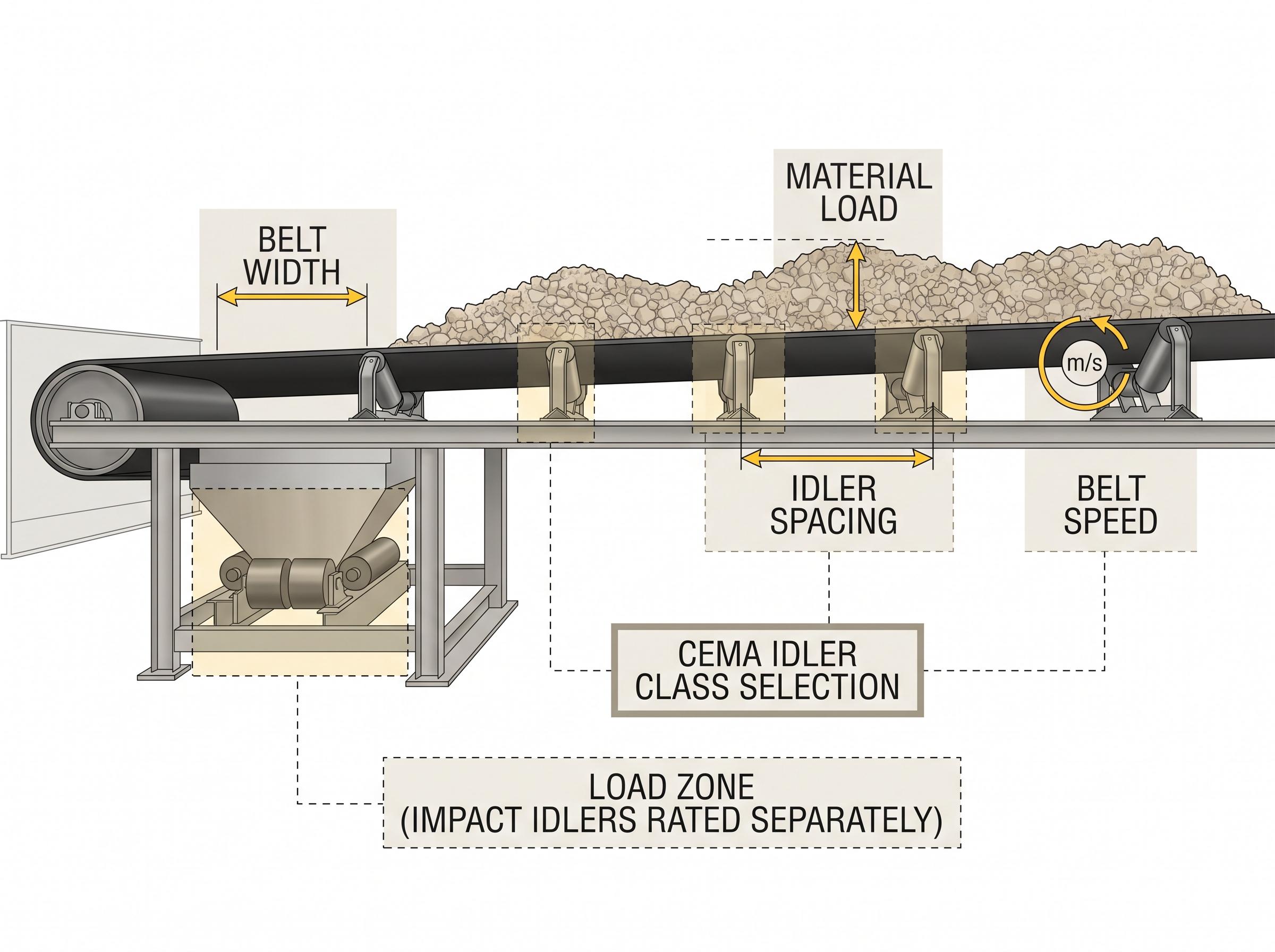
Material weight. A 48 in. belt of crushed limestone at about 90 lb/ft³ loads a roll far harder than the same belt carrying dry fly ash at about 40 lb/ft³. Use the weight of the material you actually run.
Idler spacing. Wider spacing puts more belt and more material on each roll. Bringing the spacing in a little is often cheaper than moving up a whole class.
Belt speed. Speed adds no weight to the roll, but it spins the bearing more, and that sets how long the bearing lasts. CEMA ratings are tied to a target bearing life, usually 30,000 hours. Run faster at the same load and that life drops, which can move you up a class.
Lump size and impact. This one usually only changes the answer at the load zone, covered next.
The result is a load you compare to the CEMA rating for the class at your speed. Clear the rating with a sensible margin and the class holds. Fall short and you either step up one class or bring the spacing in. That is the whole decision, and it takes a quick calculation rather than a guess.
If you want to run your own belt against real roll, bearing, and load-rating numbers, they are on the spec sheet.
At the load zone, and almost nowhere else. Material dropping from a chute hits the first few idlers with a force the running belt never sees. That is a different problem from the steady carrying load, and it has its own answer.
Use impact idlers, with cushioned rolls, in the load zone and only there.
Rate those impact idlers to the drop height and the lump size, separately from the carrying class along the rest of the belt.
Do not solve an impact problem by raising the class of every idler on the conveyor.
In retrofit work, this is one of the most common places a budget slips. The load zone really does need the extra protection. The other few hundred idlers do not, and classing all of them up to survive the first three pays mine-duty prices for what is really a chute problem.
Match the class to the material and the tonnage, then confirm it with the load calculation:
CEMA C covers most cement plant belts and general plant duty, running finished product, raw meal, or moderate tonnage.
CEMA D suits abrasive, higher-tonnage work, heavier crushed stone, clinker, and the like.
CEMA E and F are mining and aggregate territory. Taconite on the Mesabi Range, high-tonnage overland belts, and large crushed-rock runs earn the extra roll and bearing steel because the load and the abrasion are both real.
Two US realities can move the decision even when tonnage looks moderate. On belts carrying silica-bearing fines, sealing matters along with class, because the dust that shortens bearing life is often the same dust controlled at 50 µg/m³ under OSHA and MSHA. And in the Upper Midwest, cold starts around 10 °F can stiffen grease and shift belt tension, so the roll is working harder than the summer design point assumed.
A few patterns show up again and again in idler changeouts and retrofit requests:
Classing up the whole run to feel safe. It feels careful. It is really just expensive, and it usually covers up a load-zone or spacing issue a calculation would have caught.
Under-classing an abrasive duty. A class chosen on clean-material load fails early once dust reaches the bearings. Decide the seal quality and the class together, not one at a time.
Forgetting the return idlers. Return rolls carry only the empty belt, so a lighter setup often works. But they sit at walkway height and fall under MSHA guarding rules in a mine, so specify the guard along with the roll.
Since 2013, we have supplied 500+ bulk material handling systems across 15+ industries and build conveyor idlers and conveyor pulleys for cement, power, steel, and mining plants. We design and manufacture to conform to CEMA standards, and we match the carrying duty to the load instead of pushing a heavier class by default.
If tighter spacing or better sealing fixes the problem, that is usually a better answer than moving every idler up a class. And idlers that get replaced more than once a year are usually failing on the bearing side rather than by bad luck.
Not sure whether your current idlers are over- or under-classed? Send us the belt and the material, and we will run the load for you.
Choose the class from the load the idler carries, not from belt width and not from a habit of buying heavy duty to be safe.
Check the class against belt speed, because speed sets bearing life even when it adds no weight to the roll.
Rate impact only at the load zone. Classing up the whole conveyor to protect the first three idlers is the most common overspend.
Decide seal quality and class together on abrasive duty, or dust in the bearings will fail them early.
The roll, bearing, and load numbers for each class come from CEMA 502. Work against it rather than judging by belt width.
The load the idler carries, which comes from belt width, material weight, and idler spacing, checked against belt speed for bearing life. Belt width alone is only a starting point. Two belts of the same width can need different classes if one runs heavier material, moves faster, or has wider idler spacing.
No. A higher class costs more per idler in roll and bearing steel, and that cost repeats across every idler on the conveyor. If the load calculation says CEMA C carries the duty, buying E spends more without adding life. The one exception is impact at the load zone, which is rated on its own.
Each step up increases the roll diameter, shaft size, and bearing, which raises the load rating and the belt speed the idler can handle. C is medium general-plant duty, D is heavy and abrasive duty, and E is extra-heavy duty for high-tonnage aggregate and mining.
Speed adds no weight to the roll, but it spins the bearing more, so it sets how long the bearing lasts. A faster belt at the same load reaches the end of its bearing life sooner and can call for the next class up, even though the material weight on each idler has not changed.
Only at the load zone, where material drops from the chute onto the belt. Rate them to the drop height and lump size. Along the rest of the belt, use the carrying class the load calculation calls for. Raising the class of every idler to survive the load zone is the most common way plants overspend.

Delivering advanced conveyor solutions from Houston across the U.S.


