

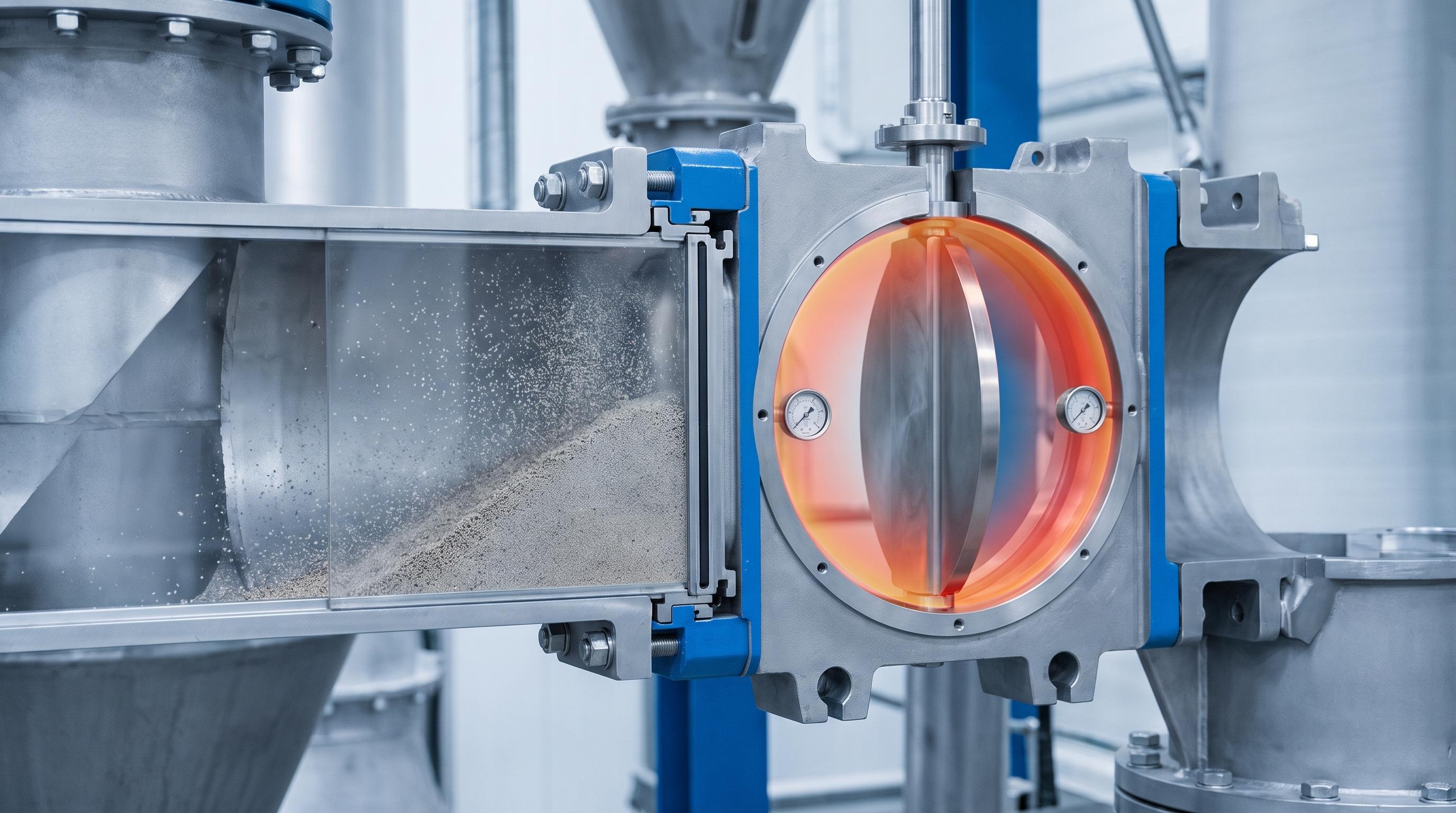
A dust-tight seal keeps solid particles from getting out. A gas-tight seal keeps gas and pressure from getting through. Every bulk handling valve, gate, and enclosure is built to one of those two jobs.
The gap between them is wide. A dust-tight gate stops powder you can see. A gas-tight gate holds a pressure difference across a closed blade. The second can cost several times the first.
Most specifications ask for tight shut-off and stop there. That one missing word decides the seat, the price, and whether the part holds in service.
This post covers what each term means, the ANSI class that sits behind them, and how to tell which one your duty actually needs.
Dust-tight stops visible particulate. Gas-tight holds a gas or pressure boundary. ANSI/FCI 70-2 puts numbers on the gap: Class I is named dust-tight and needs no leak test, while Class VI is bubble-tight. Specify the class, not just tight shut-off, or you pay for gas-tight where dust-tight would have done the job.
Dust-tight contains solids. Gas-tight contains gas and pressure. That is the whole distinction, and everything else follows from it.
A dust-tight seal is asked to stop particles. Particles are large, and they settle. A seal that blocks visible powder from escaping a chute or an enclosure is doing its job, even if air moves through it.
A gas-tight seal is asked to hold a boundary between two pressures, or to keep a gas in or out. Air is not a particle. It finds any path the seal leaves open. Holding it takes a continuous, compliant seal and a face with nothing to leak past.
So the two words describe two different physics problems. One is about catching solids. The other is about closing off a fluid. A part built for the first will not automatically do the second.
Start with the easier of the two, because it covers most bulk handling duty.
Dust-tight means fugitive particulate stays inside the equipment. Powder does not puff out of the gate when it closes. It does not drift off a transfer point. It does not collect on the floor under a valve.
This is the right target for the majority of gravity-fed dry bulk. Material dropping from a silo into a bin, a gate isolating a hopper, a cover over a transfer point. None of these carry a pressure difference worth sealing against. They just need to keep the product and the dust where they belong.
Dust-tight is also where housekeeping and exposure limits live. A gate that leaks fine powder is a cleanup cost and, with the wrong material, an air quality problem. For crystalline silica, OSHA's respirable silica rule makes fugitive dust something the plant has to control at the source. A dust-tight gate is the baseline that keeps that dust in the equipment instead of in the breathing zone.
Now the harder job, and the reason the term exists at all.
Gas-tight means the seal holds a pressure or gas boundary with the valve closed. Not just powder, but air. The seal has to stop a measurable flow driven by a pressure difference across the closed part.
You need this wherever the equipment is part of a pressure system:
A gate feeding or isolating a pneumatic conveying line
A valve on a vessel held under pressure or vacuum
An enclosure that is itself a pressure or containment boundary
A device that has to keep a combustible or hazardous atmosphere from moving through the system
The seal that does this is different in kind. It is soft and continuous, or it inflates against the blade, or it is a lapped metal face built to a much finer tolerance. It also wears, because a compliant seal in a dry bulk stream is taking abrasion the whole time it works.
That last point is the tradeoff in one line. Gas-tight buys you a pressure boundary and costs you a wear part.
Set the two side by side and the choice gets easier to see.
Dust-tight | Gas-tight | |
|---|---|---|
Stops | Solid particulate | Gas and pressure |
Seals against | Material escaping | A pressure difference |
Typical seat | Metal or standard soft | Inflatable or fine soft seat |
Where it fits | Gravity discharge, transfer points, isolation | Pneumatic lines, pressure or vacuum vessels |
Wear | Low | Higher, the seal is a service item |
Relative cost | Baseline | Several times higher |
The pattern holds across the whole product range. The more you ask a seal to hold back, the more it costs to build and the sooner it needs attention.
Dust-tight and gas-tight sound like loose shop terms. There is a US standard that puts real numbers behind them.
ANSI/FCI 70-2 defines six seat leakage classes. It was written for control valves, so it does not govern every gate or damper directly. But it is the reference the whole US industry uses to say how tight is tight, and it is worth knowing when you write a spec.
Class | Common name | Allowed seat leakage |
|---|---|---|
Class I | Dust-tight | No test required, no specified rate |
Class II | 0.5% of rated capacity | |
Class III | 0.1% of rated capacity | |
Class IV | Metal-to-metal | 0.01% of rated capacity |
Class V | Very low, for long closes at high pressure | |
Class VI | Bubble-tight | Measured in bubbles per minute, soft seat |
Notice the two ends. ANSI/FCI 70-2 literally names Class I dust-tight, and it requires no leak test at all. Class VI is bubble-tight and is measured by counting bubbles. That is the span between the two words in your title, written into one standard.
For bulk handling, the useful takeaway is the direction, not the exact percentage. If your duty is dust containment, you are near Class I. If it is a pressure boundary, you are reaching for Class VI behavior, and you should specify the soft or inflatable seat that gets you there.
Under all of this sits one decision, and it is the seat.
The seat is where the moving part meets the body. Its material decides how tight the closed valve or gate can be, and it is the single biggest lever you have.
Soft seats use rubber, EPDM, PTFE, or a polymer. They deform to close every gap, so they seal tightest, from dust-tight all the way to bubble-tight. The cost is temperature and wear. They have an upper heat limit, and abrasive material grinds them down over time.
Metal seats put metal against metal. They take heat and abrasion that would destroy a soft seat, which is why they run on clinker and other hot, sharp material. They also leak more, landing around Class IV rather than Class VI. You accept some leakage to survive the duty.
This is why the same gate body comes in more than one sealing build. Our slide gates are made in three tiers for exactly this reason. A standard seal handles general isolation. A low-leakage seal with rubber or polymer seats suits fine powders. A near-zero-leakage build with an inflatable seal gives full isolation on pneumatic and hazardous duty. The body is the same. The seat is what moves you up the tightness scale.
The spec sheet lays out which seat and sealing options reach which leakage class across the gate and valve range. It is a fast way to match a class to a real part while you are still sizing the job.
Work from the duty, not from the catalog. The question is simple once you ask it in order.
First, is there a pressure difference across the closed part? If material only falls through by gravity, you are in dust-tight territory and you can stop there. If the part sits in a pressure or vacuum line, you need gas-tight.
Second, what is the material doing to the seat? Hot or sharp material pushes you toward a metal seat and caps how tight you can hold. Fine, cool, valuable powder lets you run a soft seat and reach for the tighter class.
Here is how that lands across the three body types in the title:
Valves. A butterfly or knife gate valve takes its class from its seat. An EPDM or PTFE soft seat seals tight. A metal-to-metal seat trades tightness for heat and abrasion resistance.
Gates. A slide or guillotine gate scales from standard to near-zero-leakage by seat choice. For a true pressure boundary, the inflatable-seal build is the one that holds.
Enclosures. A transfer point cover or a dust collector housing is almost always a dust containment job, so dust-tight is the target. Gas-tight only enters when the enclosure is itself a pressure or vacuum vessel.
One more case sits on its own. A rotary airlock is built to hold a pressure difference while it keeps feeding material. That is a gas-tight duty by design, which is why an airlock, not a gate, is the usual answer where a pneumatic line meets a hopper.
Choosing the gate body itself, knife vs slide, is a separate decision from the tightness class. Settle the class first, then the body.
The price gap is real, so it helps to know what you are paying for.
A gas-tight build adds three things. It adds a compliant seal, either soft or inflatable, machined to close every path air could take. It adds tighter tolerances on the sealing face. And it adds a wear item, because that seal is working against abrasion every cycle.
None of that is markup. It is the cost of holding air instead of catching powder.
So the honest guidance is to buy gas-tight where the duty is a pressure boundary, and not before. A pneumatic line, a vacuum vessel, or a hazardous atmosphere earns it. A gate dropping cement into an open bin does not, and specifying gas-tight there buys a wear part you did not need. Our dampers are built to hold low leakage for the same reason. That is the right target for draft and isolation duty. Chasing tighter would add cost the application never uses.
Most shut-off specs we are sent say tight shut-off and nothing else. The word tight is doing a lot of quiet work, and it means something different to the buyer, the vendor, and the plant.
That is one line to fix. Name the leakage class, or at least say whether the duty is dust containment or a pressure boundary. Everything downstream, the seat, the body, the price, the wear schedule, follows from that one choice.
If a shut-off is going onto an RFQ and you are not sure which way it should go, our engineers can settle it with you. They will tell you the leakage class your duty needs and the seat that reaches it. They will also tell you whether a gate or a valve body is the right fit, before the requisition goes out. That is a five-minute call that saves a mis-specified part.
Dust-tight stops solid particulate. Gas-tight holds a gas or pressure boundary. They are two different jobs, not two grades of the same one.
ANSI/FCI 70-2 names Class I dust-tight with no test required, and Class VI bubble-tight. That standard is the span between the two terms.
The seat sets the tightness. Soft seats reach bubble-tight but wear and have heat limits. Metal seats survive heat and abrasion but leak more.
Specify gas-tight only where there is a real pressure difference. On gravity discharge, dust-tight is the right and cheaper answer.
Replace tight shut-off on the spec with a leakage class or a clear dust-versus-pressure call. Everything downstream follows from it.
Dust-tight keeps solid particulate from escaping the equipment. Gas-tight holds a gas or pressure boundary with the part closed. Dust-tight suits gravity discharge, transfer points, and isolation, where there is no pressure difference to seal against. Gas-tight is needed on pneumatic lines, pressure or vacuum vessels, and hazardous atmospheres, and it costs several times more because it needs a compliant seal that also wears.
It means fugitive powder stays inside the equipment. The gate does not puff dust when it closes, the transfer point does not drift material, and powder does not collect on the floor. Air may still pass through, which is acceptable because the job is containing solids, not holding a pressure boundary. It is the right target for most gravity-fed dry bulk.
Under ANSI/FCI 70-2, Class I is literally named dust-tight and requires no leakage test. The classes tighten from there: Class IV is metal-to-metal at 0.01% of rated capacity, and Class VI is bubble-tight with a soft seat, measured in bubbles per minute. The standard was written for control valves, but it is the reference the US industry uses to define how tight a shut-off is.
A soft seat is tighter. Rubber, EPDM, PTFE, and polymer seats deform to close every gap, so they can reach bubble-tight. Metal-to-metal seats leak more, around Class IV, but they take the heat and abrasion that would destroy a soft seat. That is why hot, sharp duty like clinker runs metal seats and accepts some leakage.
Yes. A pneumatic line carries a pressure difference, so the shut-off has to hold gas, not just powder. That means a soft or inflatable seal rated for the pressure, or a rotary airlock, which is built to hold a pressure difference while it keeps feeding. A standard dust-tight gate will leak air on that duty and will not maintain the line pressure.
A dust-tight gate is the baseline for keeping respirable silica inside the equipment instead of in the air. OSHA's respirable crystalline silica rule requires plants to control fugitive dust at the source, and a gate that leaks fine powder works against that. Dust-tight sealing is a starting point, alongside the enclosure and collection design for the whole transfer point.
Whatever matches your duty and no more. If material only falls through by gravity, dust-tight is the right and lowest-cost answer. Reach for gas-tight only when there is a real pressure or vacuum difference, a pneumatic line, or a hazardous atmosphere to contain. Specifying gas-tight on a gravity gate buys a wear part the application never uses.

Delivering advanced conveyor solutions from Houston across the U.S.


