

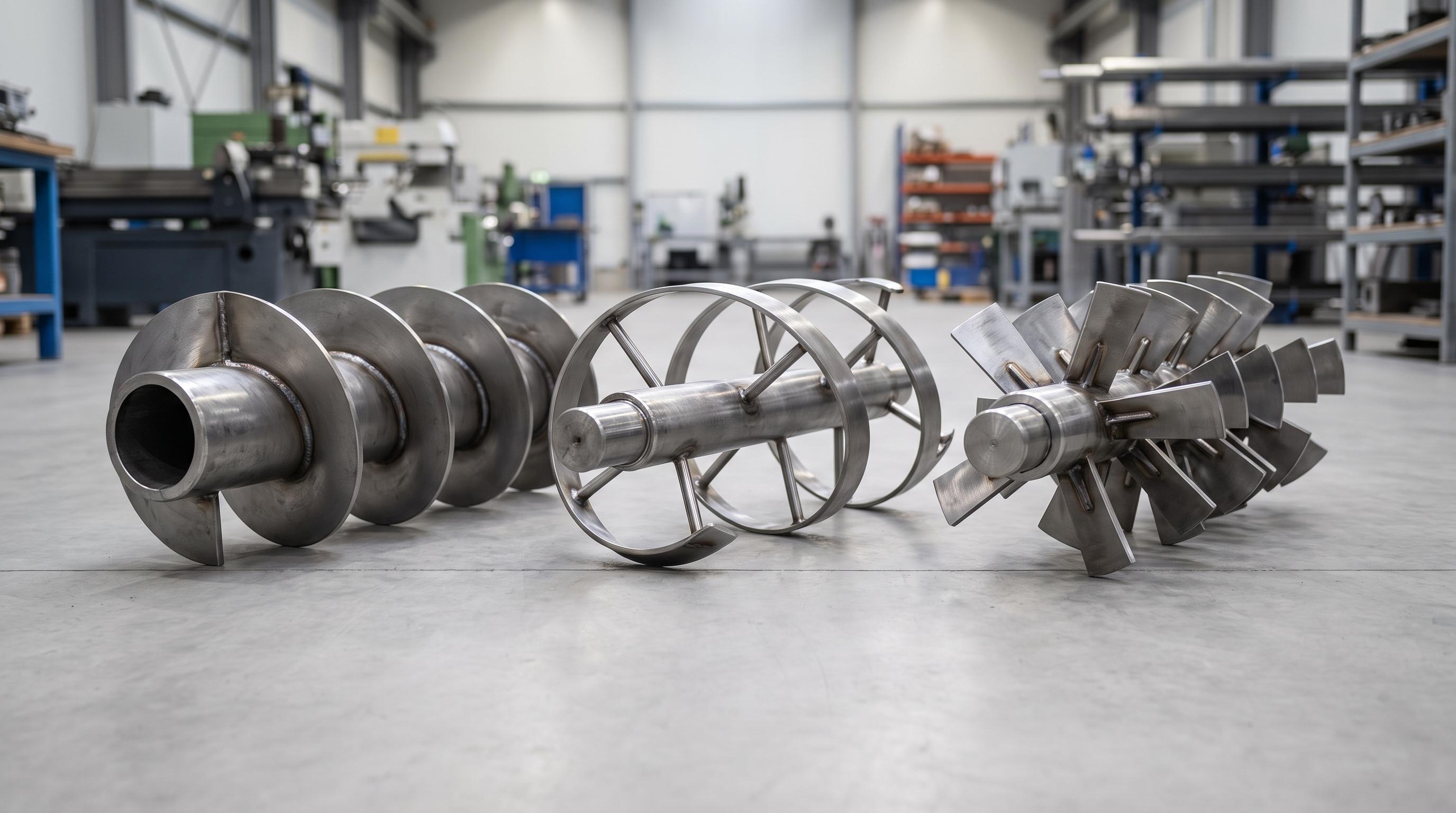
Flight selection is not a sizing choice; it is a material-handling decision. A flight that conveys grain efficiently may compact wet sludge against the shaft, while a mixing flight will not deliver the same throughput as a full-flight screw. Match the geometry to the material and duty, and the conveyor runs reliably; mismatch it and plugging, accelerated wear, and capacity loss follow.
Quick way to choose: start with the material, then set the pitch for the duty. Use standard flighting for free-flowing bulk solids. Use ribbon or shaftless designs for sticky material that can pack on the center pipe. Use cut or paddle flighting when the job requires lump breakup, agitation, or mixing. Then set pitch to match the application: standard pitch for horizontal conveying, short or half pitch for incline or feeder duty, and variable or tapered pitch for controlled withdrawal under a hopper.
Flighting is the helical blade wrapped around the screw that pushes material forward as the screw turns.
It is manufactured in two primary forms. Helicoid flighting is rolled from flat strip into a continuous helix and is commonly used for standard pitches and lighter-duty service. Sectional flighting is formed from individual segments welded to the center pipe and is better suited to heavy-duty applications and specialized flight geometries. Both perform the same conveying function; the distinction lies in their method of manufacture and their structural integrity under heavy operational loads and severe wear.
Two things about a flight are chosen separately, and confusing them is where a lot of screw conveyors go wrong:
Flight geometry, the shape of the blade, is chosen for how the material behaves.
Pitch, the distance between one turn and the next, is chosen for the duty: horizontal, inclined, feeding, or high capacity.
You pick the geometry for the material and the pitch for the job. The rest of this guide takes them in that order.
The geometry of the flight decides how the material is carried, mixed, or released. Five types cover almost all bulk duty.
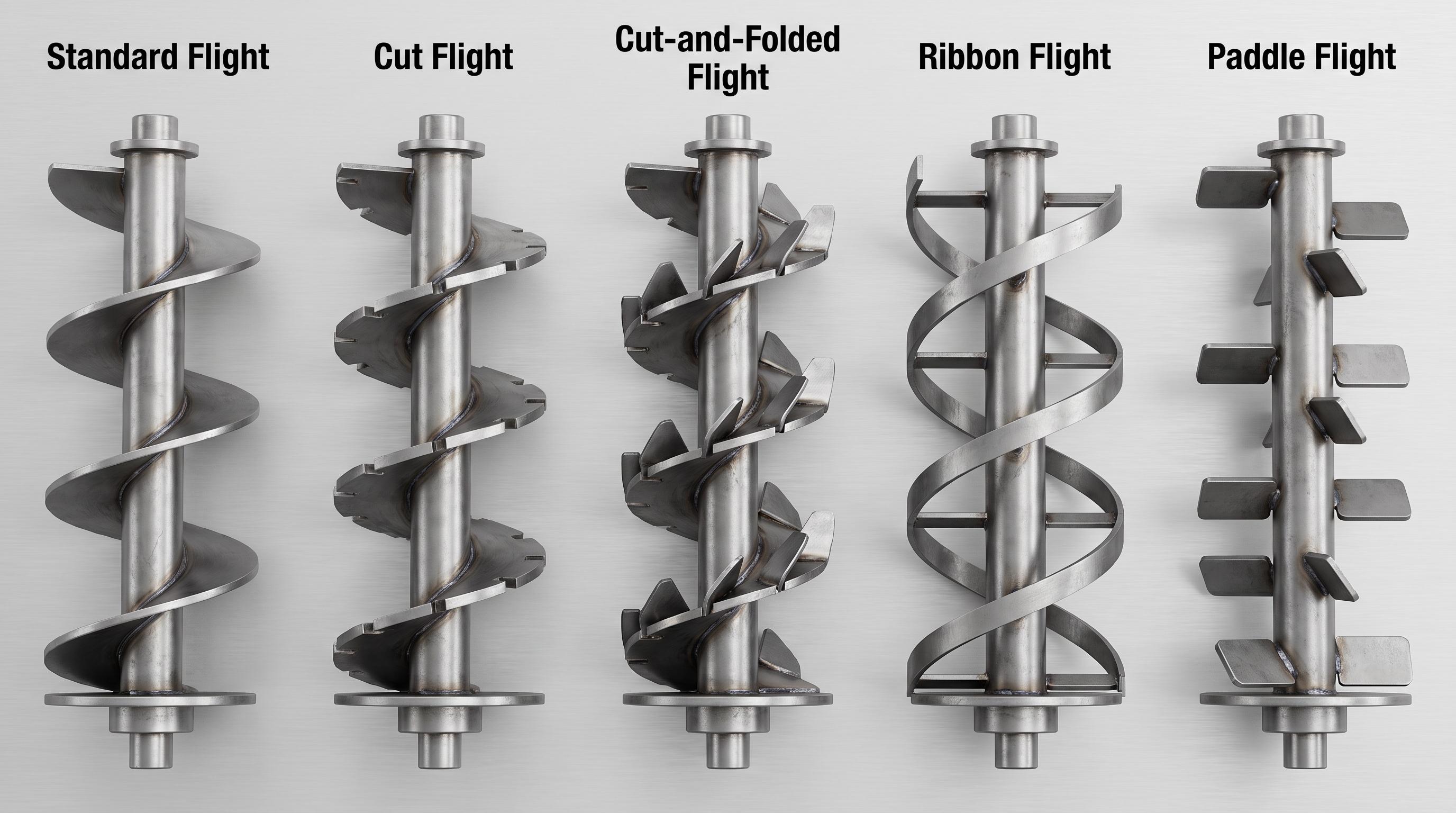
Flight type | What it is | Best for |
|---|---|---|
Standard (full) flight | A solid, continuous helix | Free-flowing, non-abrasive material; the default |
Cut flight | Notches cut into the outer edge | Lumpy material and light mixing while conveying |
Cut-and-folded flight | Notched, with sections folded up | Aerating, heating, or cooling light material |
Ribbon flight | An open helix held off the shaft on spokes | Sticky, wet, or gummy material |
Paddle | Separate paddles instead of a continuous helix | Mixing and slow, controlled movement, not conveying |
The one worth understanding is the ribbon flight because it solves a problem a standard flight cannot. On sticky material, a standard flight packs product into the corner where the blade meets the shaft, and the buildup grows until the screw is dragging a solid core. A ribbon flight has no continuous web joining the blade to the shaft, so there is no corner to pack. The open center is why ribbon flighting handles wet fly ash, sludge, and other clinging material that would seize a standard screw. If the wider equipment choice is still open, this screw vs pneumatic conveyor comparison explains why sticky material usually stays on a screw rather than moving to a pneumatic line.
One of the earliest signs that a standard flight is wrong for the duty is material starting to cake at the shaft, even when the screw is otherwise sized correctly. Sticky material can force frequent cleanout until the screw is changed to an open-center design.
Cut and cut-and-folded flights work the opposite way. Instead of moving material cleanly, they interrupt it, so it tumbles and mixes as it goes. Use them when the duty is as much about blending or aerating as conveying. Paddles take that further and are really a mixer, not a conveyor, so if your target rate is stated in ft³/hr or TPH, expect a lower throughput than a standard full-flight screw of the same diameter and speed.
Pitch is the spacing of the flights, and engineers choose it for the duty, not the material.
Standard pitch sets the pitch equal to the screw diameter. It covers horizontal conveying and modest inclines, and it is the default.
Short and half pitch tighten the spacing to two-thirds or one-half. They hold material better on inclines and in vertical screws, and they meter material evenly in feeders.
Long pitch opens the spacing past the diameter. It moves free-flowing material quickly and agitates fluid material.
Variable pitch increases the pitch along the length. In a screw feeder under a hopper, it draws material evenly along the whole inlet instead of pulling it all from one end.
Tapered pitch does the same job for lumpy material under a feeder, giving uniform withdrawal.
The rule of thumb: horizontal and general conveying takes standard pitch; anything on a slope or acting as a feeder takes short, half, variable, or tapered pitch. A conveyor that has to climb loses capacity fast on standard pitch, which is why inclined screws move to short pitch when the design has to hold a target throughput in ft³/hr or TPH instead of giving back rate on the incline. For a standards-based starting point on inclined and vertical screw design, see CEMA’s inclined and vertical screw conveyor guide.
Most type lists do not fully resolve this step. Start with the material's flow characteristics and bulk handling behavior, then select the flight geometry accordingly.
If your material is | Use | Why |
|---|---|---|
Free-flowing, non-abrasive (grain, dry powder) | Standard full flight, standard pitch | Moves cleanly, nothing special needed |
Sticky, wet, or gummy (sludge, wet fly ash, biosolids) | Ribbon flight, or a shaftless spiral | Open center gives the material nowhere to pack |
Lumpy or agglomerated | Cut flight | Cutting edges break lumps while conveying |
Needs mixing or aerating (blends, cooling) | Cut-and-folded or paddle flight | Folds and paddles turn and lift the material |
Abrasive (clinker, frac sand, fly ash) | Standard flight, hardsurfaced or AR steel | Keep the geometry, add wear protection to the edge |
Fragile (needs gentle handling) | Long pitch, run slower | Wider spacing and lower speed reduce shearing |
Two material properties drive most of the decision. Stickiness decides whether you can use a standard flight at all, or whether you need the open center of a ribbon or shaftless design. Abrasiveness does not usually change the flight shape, but it decides the flight material and whether the edge is hardsurfaced.
The screw conveyors we build cover this range, in diameters from about 6 to 24 inches. They run standard helicoid flights for grain and dry powder, and shaftless or ribbon designs for sticky material like dewatered sludge and wet fly ash.
In practice, final sizing is set by the required duty in ft³/hr or TPH, along with the material behavior, incline, and wear conditions. On feeder-duty work, throughput can drift when pitch and inlet geometry are not matched to the withdrawal pattern under the hopper. The spec sheet lists the flight, trough, and construction options so you can match a screw to your material before you specify it.
Flight construction determines how long a screw lasts in abrasive service and how reliably it clears sticky material. Geometry still matters, but flight material, edge treatment, shaft design, and trough style usually decide service life and cleanout performance.
For abrasive material, keep the standard flight shape and upgrade the construction. Abrasion-resistant steel and hardsurfacing on the outer edge protect the flight where wear opens the gap to the trough, drops capacity, and raises horsepower. On clinker, fly ash, and frac sand, outer-edge wear usually shows up before the flight looks fully spent, so track throughput and power draw, not just visual wear. When comparing wear-grade materials, SSAB’s Hardox wear steel guide is a useful reference point for abrasion-resistant plate options.
For sticky material, prevent buildup at the shaft and inside the trough. Ribbon flighting removes the corner where material packs against the center pipe, and a shaftless spiral removes the center pipe entirely for the most difficult wet service. Use them for sludge, biosolids, and other material that needs predictable cleanout.
Trough construction should match the service. Use a U-trough for general duty, a tubular housing for fine dusty material such as cement and lime, and a jacketed trough when the process needs heating or cooling. Select the trough with the same CEMA-based discipline as the flight and pitch. During inspection and maintenance planning, keep guarding and access aligned with OSHA conveyor safety requirements as well.
Running a standard flight on sticky material. It packs against the shaft, builds a solid core, and the screw ends up dragging instead of conveying. Ribbon or shaftless is the answer.
Ignoring pitch on an incline. A standard-pitch screw loses capacity fast on a slope. Inclined and vertical screws need short or half pitch to hold material.
Skipping hardsurfacing on abrasive material. The flight edge wears, the gap to the trough opens, capacity drops, and horsepower climbs until the flight fails.
Expecting a mixing flight to convey at full rate. Cut, cut-and-folded, and paddle flights trade conveying capacity for mixing. If you need both, size for the lower rate.
Choosing flighting from a catalog without the material data. Bulk density, stickiness, abrasiveness, and lump size all drive the choice, and a flight picked without them is a guess.
Start with the material-handling problem, then size the conveyor around that decision. For demanding applications, our engineers evaluate material flow characteristics, duty cycle, pitch, and construction requirements to recommend a flight configuration that supports reliable capacity, wear life, and maintainability.
Choose flight geometry for how the material behaves, and choose pitch for the duty.
Use standard full flight for free-flowing material, and move to ribbon or shaftless designs when sticky material can pack at the shaft.
Use cut, cut-and-folded, or paddle flights when the duty includes lump breakup, agitation, or mixing, and expect lower conveying capacity than a full-flight screw.
For abrasive material keep the geometry that fits the duty, then add wear protection through abrasion-resistant steel or hardsurfaced edges.
On inclines and feeder duty use short, half, variable, or tapered pitch to hold material properly and withdraw it more evenly.
The main flight types are standard (full) flight, a solid continuous helix for free-flowing material; cut flight, notched to break lumps and mix lightly; cut-and-folded flight, for aerating, heating, or cooling; ribbon flight, an open helix for sticky material; and paddle, which mixes rather than conveys. Pitch types, which are a separate choice, include standard, short, half, long, variable, and tapered.
A ribbon flight or a shaftless spiral. Sticky material packs into the corner where a standard flight meets the shaft, building up until the screw drags a solid core. A ribbon flight has no continuous web joining the blade to the shaft, and a shaftless spiral has no shaft at all, so the material has nowhere to build. This is why dewatered sludge, biosolids, and wet fly ash run on ribbon or shaftless screws.
Flight refers to the geometry of the helical blade; pitch refers to the distance between one turn of the blade and the next. Flight geometry is selected according to material flow characteristics and bulk handling behavior, whether the material is sticky, lumpy, abrasive, or free-flowing. Pitch is selected according to operating duty: standard pitch for horizontal conveying, short or half pitch for inclined and feeder service, and long pitch for higher-capacity movement of free-flowing material.
Short pitch or half pitch. A standard-pitch screw loses capacity quickly as the incline increases, because material tends to fall back over the flight. Reducing the pitch to two-thirds or one-half of the diameter holds the material better on the slope. Steep inclines and vertical screws almost always use reduced pitch.
A standard flight shape, made from abrasion-resistant steel and hardsurfaced along the outer edge. Abrasive material such as clinker, frac sand, and fly ash wears the flight diameter, which opens the gap to the trough, drops capacity, and raises horsepower. The shape does not change, but the material and edge treatment do.
A cut flight has notches cut into the outer edge, which break up lumps and mix material lightly as it is conveyed. It suits material that tends to agglomerate or needs some agitation on the way through. A cut-and-folded flight goes further, folding sections up for more aggressive mixing, aerating, heating, or cooling of light material.

Delivering advanced conveyor solutions from Houston across the U.S.


