
Bulk Material Handling
Screw Conveyor vs Pneumatic Conveyor: How to Choose the Right One

Vijay Baid
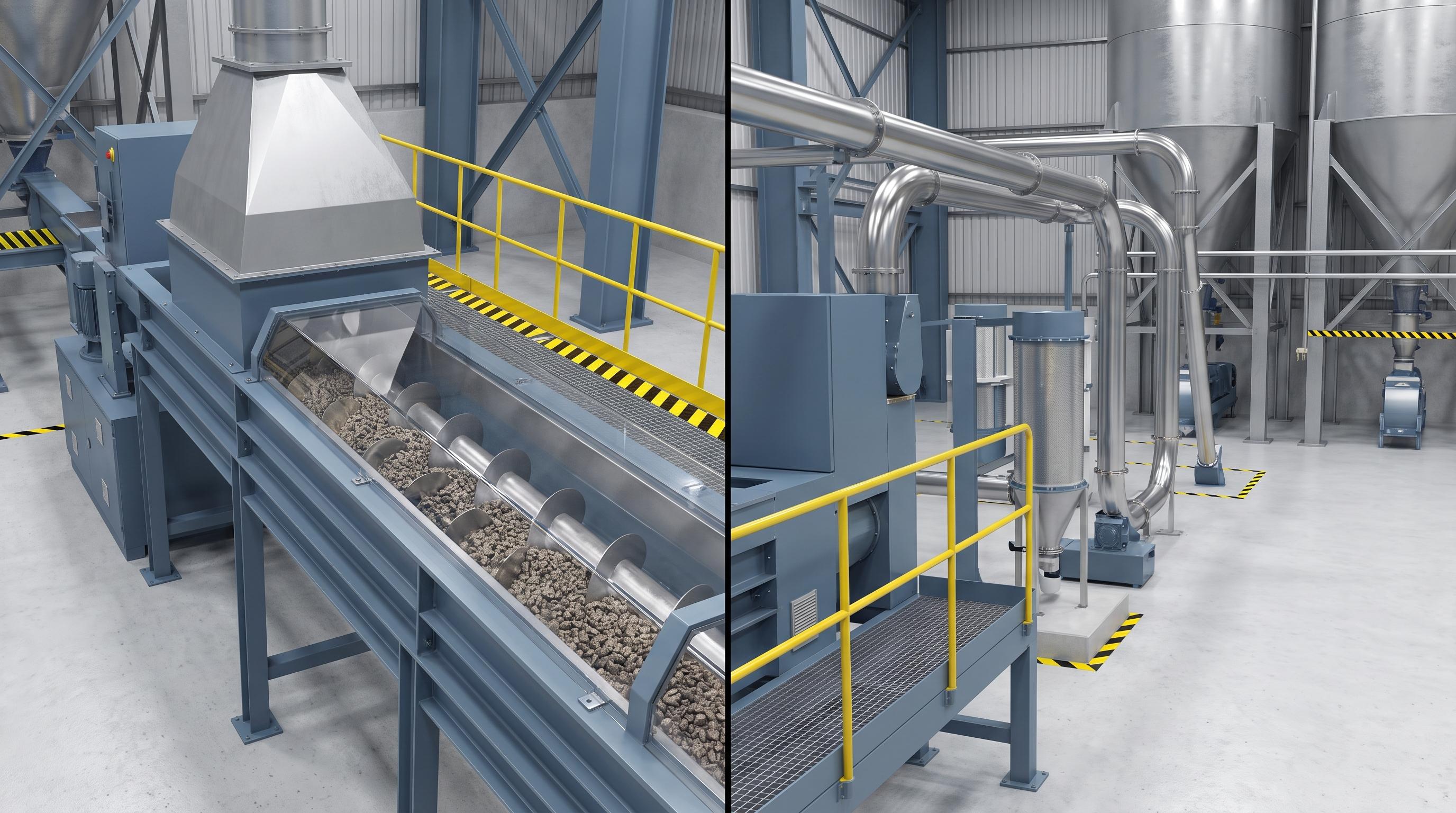
Choose a screw conveyor for short, enclosed runs of heavy, wet, or abrasive material at steady rates. Choose pneumatic conveying for dry, free-flowing powder that has to travel a distance, change elevation, or feed several points. That covers most projects. The rest come down to the details of the material and the layout, and that is where choosing wrong gets expensive. This guide walks the factors that decide it, drawn from the engineering behind the screw conveyors, feeders, and rotary airlocks that bulk-handling plants run on.
The choice turns on four things in order, material, route, throughput, then wear and dust. Get the material right first, because a wet or sticky feed rules out a pneumatic line before any other factor matters. Many plants run both, and use each where it fits best.
How each system moves material
A screw conveyor uses a rotating helical flight inside a trough or tube. The flight pushes material along mechanically, and the enclosure keeps most of it contained. Capacity scales with diameter, speed, and trough loading, sized against ANSI/CEMA Standard No. 350, the industry standard for screw conveyor design.
Pneumatic conveying carries material as a stream inside a sealed pipe using air, and it runs in one of two modes. The mode you choose drives wear, energy, and product quality.
Dilute phase suspends material in a fast air stream. It is simple and forgiving to run, but the speed is hard on fragile or abrasive material and wears pipe elbows.
Dense phase pushes slow-moving slugs at lower speed. It is gentler on the product and uses less air, but it needs more control and a material that will form slugs cleanly.
If your product is fragile or abrasive, this is the choice to get right early, because the two modes can treat the same material very differently.
Screw conveyor vs pneumatic conveyor at a glance
Here is roughly how the two compare across the factors that decide the choice. Treat it as a starting point, not a rulebook, because material behavior can shift any row.
Factor | Screw conveyor | Pneumatic conveyor |
|---|---|---|
Best-suited material | Wet, sticky, dense, abrasive, or hot | Dry, free-flowing powders |
Route | Short to moderate, mostly straight | Long, complex, and vertical routing |
Throughput | High, steady tonnage | Moderate, often up to a few hundred TPH |
Energy per ton | Lower, drive motor only | Higher, blower or compressor plus air |
Product degradation | Low | Higher, worst in dilute phase |
Dust containment | Good, seal the transfer points | Strong, sealed pipe end to end |
Layout | Rigid, straight path | Flexible, small footprint, multi-point |
Factor 1: Match the material first
Pneumatic conveying needs dry, free-flowing powder; a screw handles the wet, sticky, dense, and abrasive material a pneumatic line cannot. As a rule of thumb, free surface moisture above about 1% starts to raise plugging risk in many pneumatic applications, and by roughly 2–3% many fine powders become cohesive enough to cake or blind a line unless the material is tested and the system is designed around it. A screw handles wet, sticky, dense, hot, and abrasive material far more reliably.
A few situations show the split clearly. Fine, dry fly ash off a baghouse moves well through a pneumatic line to distant silos. Damp filter cake or sludge in a chemical or wastewater plant tends to cake and blind a pneumatic pipe, so a screw, often a shaftless screw, is the safer call. When a material is borderline, a short bench test tells you how it will actually convey. Bulk density, particle size, angle of repose, friability, and abrasiveness decide the outcome more reliably than a spec sheet.
Factor 2: Map the route and layout
A screw suits short, mostly straight runs; a pneumatic line handles distance, bends, and vertical lifts without much trouble. A single screw has a practical length limit, so longer paths use units in series, and the route has to stay fairly rigid and direct. A screw also loses capacity as it climbs, so steep lifts and vertical runs quickly favor another method.
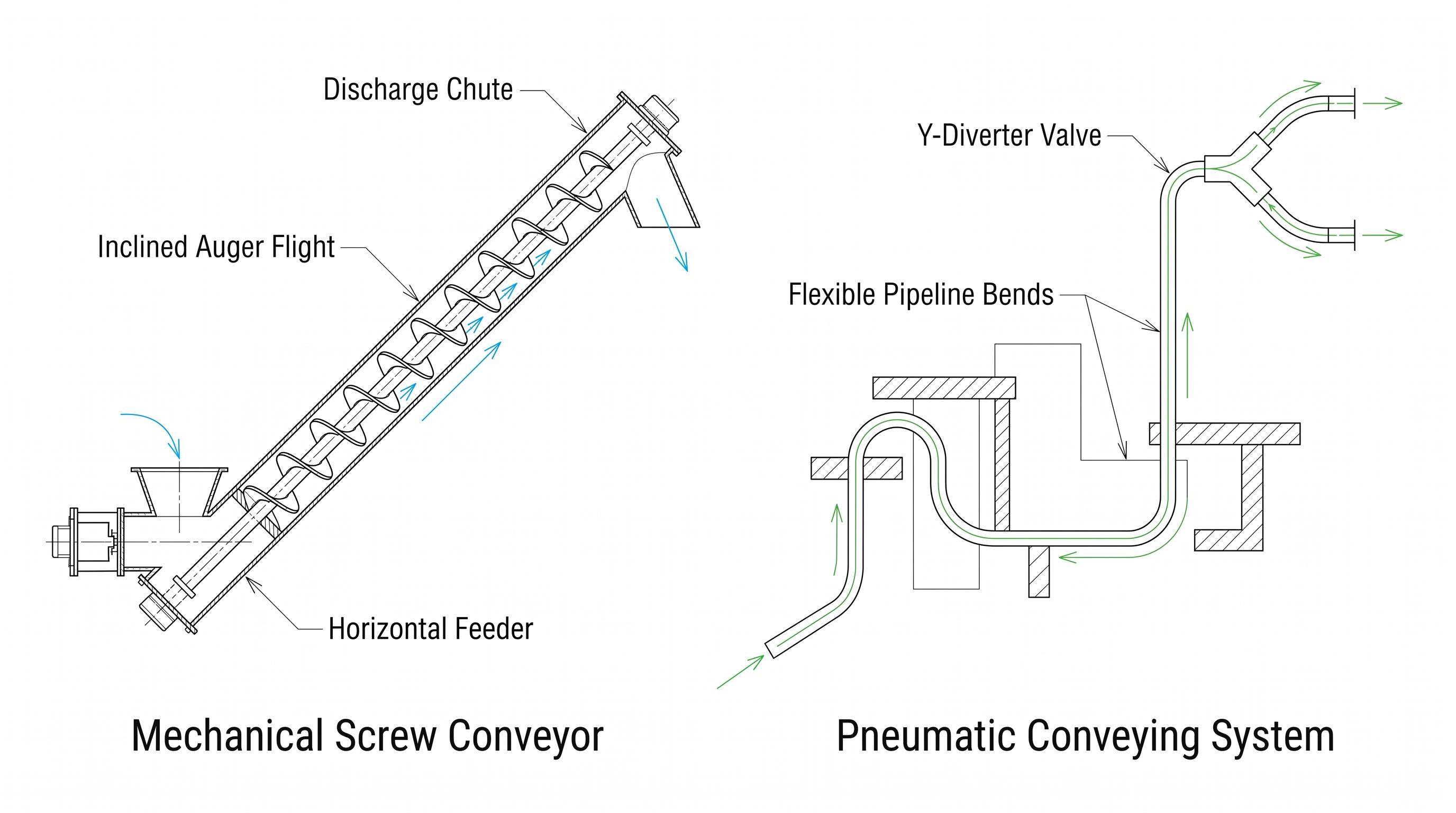
Pneumatic conveying is the flexible option. A pipe can route around structural steel, run overhead, climb vertically, and split to several discharge points from one source. It also holds a smaller footprint, which is why many cement and fly ash plants favor it inside crowded buildings. When the route has to weave through an existing plant, a single pipe is often simpler to install than a mechanical run with several transfers.
Factor 3: Weigh throughput, energy, and true cost
A screw costs less to run on high, steady tonnage over a short route; compare the two on total cost of ownership, not purchase price. A screw scales capacity with diameter and speed and needs only a drive motor, so its running cost stays low for continuous transfer between process steps.
Pneumatic systems usually carry a lower ceiling in general plant duty, often about 5 to 30 TPH in dilute phase and about 20 to 100+ TPH in dense phase, though specialized systems can run higher when distance, material, and pressure allow. Screw conveyors routinely handle tens to hundreds of TPH on short, direct runs, and large designs can go beyond that when bulk density and loading support it. They also need a dust collector or filter receiver sized for that airflow, which is capital and maintenance that first estimates often miss. Compare the two over the life of the line: capital, energy per ton, wear parts like airlock rotors, elbows, and flights, and filter media. That view usually favors the screw on short, high-rate duty and pneumatic on reach and routing.
Not sure which way to go? Our engineers will help you pick the method that fits your material and layout, before you commit to hardware.
Factor 4: Wear, degradation, and product integrity
Pneumatic conveying is harder on both the product and the pipe, and dilute phase causes most of that wear. Fragile products suffer first. Plastic resin can shed fines and form the fine strands known as angel hair, and sugar or other friable powders break down into dust. Abrasive powders wear the line fastest at the bends, so those corners need wear-resistant elbows.
There is a subtler risk with blends. The turbulence in a fast dilute line can de-mix a formulation, separating it by particle size or density, which shows up as off-spec product in premixes, spices, and pharma powders. Dense-phase plug flow keeps a blend intact. A screw conveyor is generally gentle and handles abrasives with hard-faced flights and trough liners; its weak spot is sticky material that packs against the flight, which the right flight type reduces.
Factor 5: Dust, containment, and combustible-dust safety
A sealed pneumatic pipe contains dust better than a screw trough, but combustible dust needs more than an enclosure. For fine powders where fugitive dust is a real concern, that end-to-end seal can tip the decision on its own. A screw trough is enclosed too, though open transfer points still need proper sealing, and "enclosed" is not the same as "dust-tight."
Where the powder is combustible, containment is only part of the job. Cement, fly ash, flour, sugar, metal, and many chemical powders carry an explosion risk that has to be managed whatever the conveyor. The regulatory baseline is OSHA's guidance on combustible dust, and the technical rules now sit under NFPA 660, which consolidates the former combustible-dust standards into one document. Rotary airlocks often double as isolation devices that stop a flame front spreading between equipment, but ignition control, explosion protection, and housekeeping matter as much as the conveying method you pick.
Common mistakes to avoid
Most conveying problems trace back to sizing on a single factor and missing the others. These are the ones that recur.
Sizing a pneumatic line on distance alone. Ignore what velocity does to the product and you get angel hair in resin lines or fines in sugar and food powders.
Running dilute phase for fragile or abrasive material. Dense phase moves it slowly and protects it, so reaching for dilute by default is a costly habit.
Under-specifying the rotary airlock that feeds the line. The feed valve sets how steadily material enters the pipe, and an undersized one starves the line and stirs dust at the feed point.
Forgetting the air has to go somewhere. An undersized filter receiver or dust collector blinds off and chokes the whole line.
Treating a damp material as pneumatic-ready. Even modest moisture causes buildup, so either dry it upstream or put it on a screw.
How to choose, in the right order
Run it as a sequence and stop the moment a factor makes the call.
Material. Wet, sticky, or bridging? Go screw, and you are done. Dry and free-flowing keeps both on the table.
Route. Long, vertical, or feeding several points? Pneumatic. Short and straight? Screw.
Throughput. Very high, steady tonnage on a short run tips it back to a screw.
Wear, energy, and dust. Fragile or abrasive over distance, or a strict dust limit, means dense-phase pneumatic; a tight energy budget on a short run means a screw.
When the answer is both: hybrid systems
Most plants run more than one method in a chain, and the handoffs between them decide reliability. A common flow: a silo discharges into a screw feeder that meters material at a steady rate, the feeder drops into a rotary airlock that seals the pressure boundary and feeds the pneumatic line, diverter valves split that line to several silos or day bins, and slide or knife gates isolate sections for maintenance.
Every handoff is a place the system can fail. A surging feeder upsets the air-to-material ratio. An airlock with worn clearances leaks conveying air backward and quietly cuts capacity. A diverter that does not seal cross-contaminates products, and a jammed gate strands a whole section. In practice, the mechanical interface hardware decides how well the pneumatic line runs, as much as the pipe and blower do.
That is where a components-and-solutions approach pays off. The goal is not to sell one conveying method for the whole plant, but to put the right method on each leg and get the interfaces right. UGESL engineers that mechanical side, the screw feeders, rotary airlocks, diverter valves, and gates that feed and control a pneumatic line, matched to the material and duty.
Need specs for screw feeders, rotary airlocks, or other pneumatic line components? Download the specification sheet for the feed and control equipment used to match material and duty.
Key Takeaways
Screws suit short, enclosed runs of heavy, wet, sticky, or abrasive material at steady, high tonnage; pneumatic suits dry powder that travels far, climbs, or feeds several points.
Dilute phase runs fast and forgiving but is hard on fragile material; dense phase runs slow and gentle, so match the mode to the product.
Compare on total cost of ownership, capital plus energy, wear parts, and filter media, not on purchase price.
Combustible dust needs an OSHA and NFPA 660 driven design, whatever the conveying method.
Many plants combine both, so the screw feeder, rotary airlock, and diverter components decide how well the whole line runs.
Frequently Asked Questions
Dilute phase uses a lot of fast-moving air to keep material fully suspended in the pipe. It is simpler to run but harder on the product. Dense phase uses less air at higher pressure to push slow-moving slugs of material. It is gentler on fragile and abrasive powders and uses less energy per foot, but it needs more control.
A screw conveyor uses less energy per ton for short, direct transfer, because it needs only a drive motor. A pneumatic system also has to power a blower or compressor and its air handling, so energy per ton runs higher. Over long distances the gap narrows, especially in dense phase, which uses less air per foot.
Pneumatic conveying needs genuinely dry, free-flowing powder, and even modest moisture causes buildup that grows into a plug. A screw, and a shaftless screw in particular, tolerates damp and sticky material well. If the process needs a pneumatic line, plan to dry the material upstream first.
A screw conveyor has more moving parts in contact with the material, so flights, bearings, and seals wear and need routine attention. A pneumatic line has fewer contact parts, but it adds a blower or compressor, a feed airlock, and a filter receiver, each with its own upkeep. The screw is simpler to service; the pneumatic system spreads its maintenance across more components.
Dense phase, in most cases. Its low velocity limits both particle breakage and pipe wear, which is what abrasive and fragile products need. Dilute phase runs fast, so it tends to erode elbows and degrade friable material like resin, sugar, and fine chemicals.
A single screw has a practical length limit, and units in series extend it only so far before cost and alignment become a problem. Pneumatic lines handle much longer distances, into the hundreds or thousands of feet, plus vertical lifts and multiple discharge points, which is usually where they cost less to install.
Sometimes, but it is not a straight swap. You add a feed airlock, a blower or compressor, and a filter receiver, and you rethink the route around them. It is often cheaper to keep the screw where it works and add pneumatic conveying only on the legs that genuinely need distance or routing flexibility.
An enclosed screw helps contain the dust, but no conveyor is automatically compliant. Combustible powders need a design built around OSHA guidance and NFPA 660, covering ignition control, explosion protection, and housekeeping. The conveying method is one piece of that, not the whole answer.