

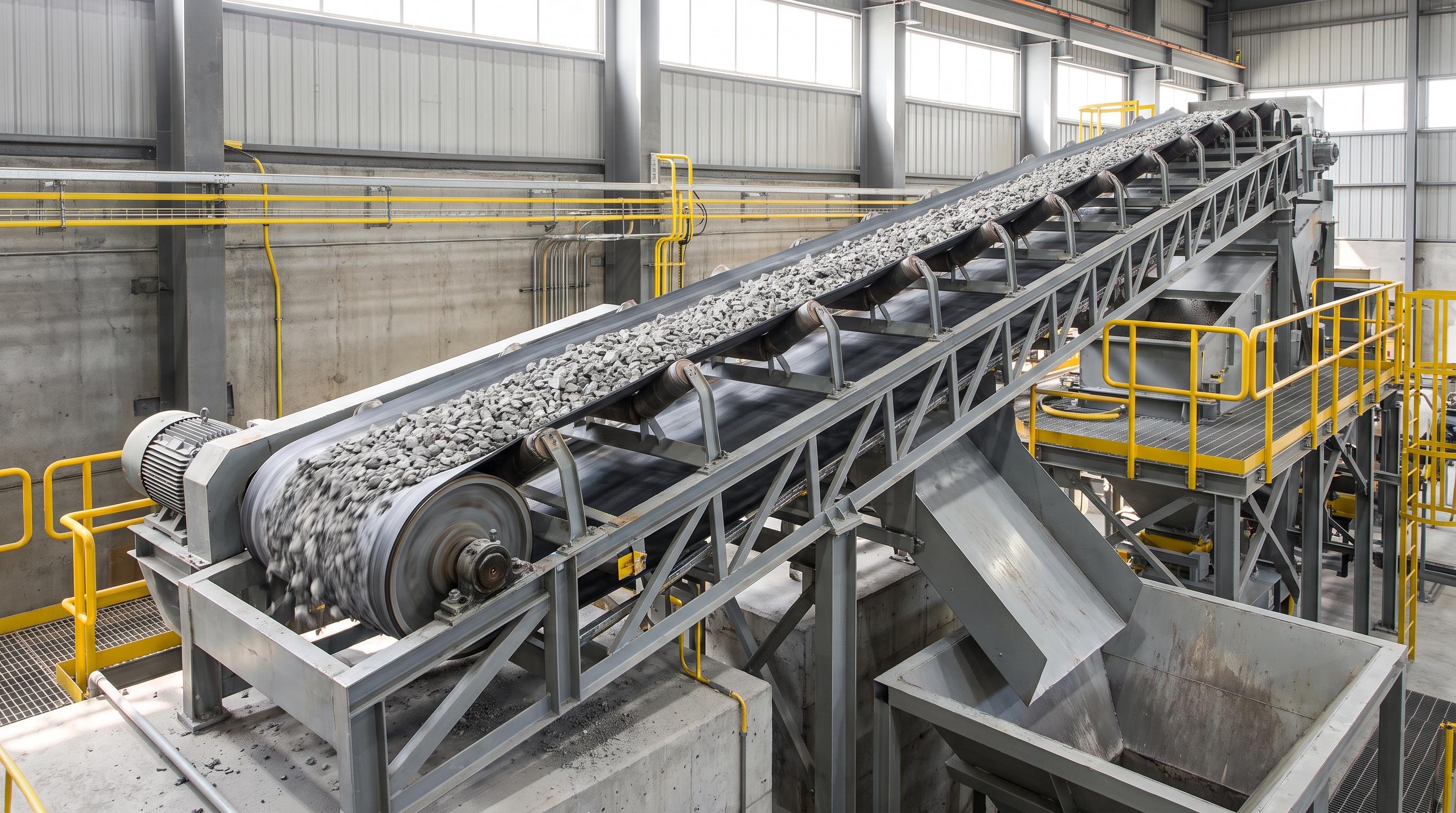
Most bulk material handling looks simple from the outside: load the material, carry it, and discharge it where the next process begins. But a belt conveyor only stays simple in service when the belt, pulleys, idlers, chute, and take-up are working as one system. That is what this guide explains: the parts, the common conveyor types, and how the machine actually works in practice.
A belt conveyor is a continuous powered belt looped around a drive pulley and a tail pulley, supported by idlers. Material is loaded at one end, carried along the top run, and discharged at the other while the empty belt returns underneath. The main parts are the belt, pulleys, idlers, take-up, drive unit, and frame, and most bulk plants use troughed conveyors sized to the material, tonnage, and route.
It is a machine that carries material on a moving belt supported between two pulleys.
The belt is a continuous loop. It runs forward along the top, carrying the load, then returns empty along the bottom to the start. A pulley anchors each end, and a motor drives one of them, usually at the discharge. Everything else on the conveyor exists to support the belt, keep it under tension, and keep it tracking straight.
What makes belt conveyors so widely used is their range. A single flight can run a few feet across a plant or several hundred feet between buildings, and longer runs are built by joining flights or using overland designs. In US practice, sizing is usually discussed in belt width in inches, length in feet, and capacity in tons per hour. In general, practical capacity and flight length depend on the material, the lump size, the incline, the belt rating, and the transfer design. They handle everything from fine powder to run-of-mine lumps, at rates from a few tons an hour into the thousands.
The running cost is often low because running power is largely driven by friction, lift, and the material load over the route rather than repeated stop-start handling. That is what makes a belt a strong choice for continuous bulk flow.
The motor turns the drive pulley, and friction between the pulley and the belt pulls the belt along.
The sequence, start to finish:
The drive unit, a motor and gearbox, turns the drive pulley at the discharge end.
Friction between the lagged pulley face and the belt drags the belt forward.
The idlers underneath support the belt and shape it into a trough so it holds more material.
Material is loaded near the tail and rides the belt to the head.
At the head, the belt bends around the drive pulley and the material discharges into a chute.
The empty belt returns along the bottom to the tail, and the loop repeats.
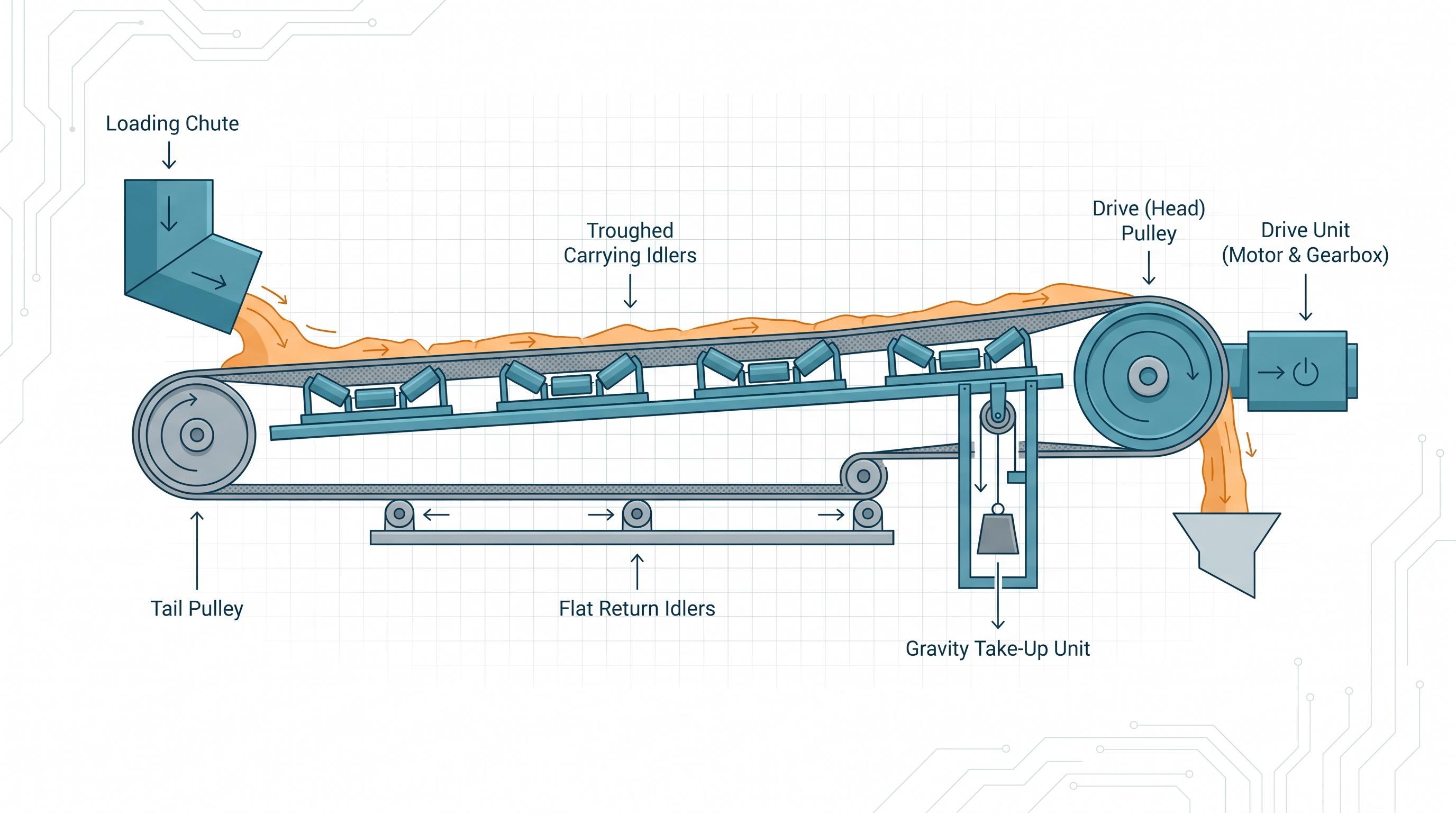
Two things decide whether it runs cleanly: tension and tracking. A take-up holds the belt tight enough that the drive pulley grips without slipping. And the belt has to stay centered, which depends on the pulleys, idlers, and structure all being in line. In practice, we rarely find belt wander starting at the belt itself. More often, the drift starts upstream where material is being loaded off-center or an idler frame has gone out of line after routine maintenance. Get tension and alignment right and a belt conveyor runs for years with little attention.
A belt conveyor looks simple, but it is an assembly of parts that each do one job.
Part | What it does |
|---|---|
Belt | Carries the material and transmits the pull from the drive |
Drive pulley | Powered pulley that moves the belt by friction, usually at the head |
Tail pulley | Turns the belt around at the loading end |
Idlers | Rollers that support the belt and shape it into a trough |
Take-up | Keeps the belt under tension as it stretches |
Drive unit | Motor and gearbox that turn the drive pulley |
Frame and structure | Holds every part in line and sets the conveyor path |
Transfer chute | Guides material onto and off the belt |
Three of these decide most of how a conveyor performs in service.
Idlers carry the whole load. On the carrying side they are set in a trough to hold more material; on the return they support the empty belt. The idler class has to match the belt tension, the material weight, and the impact at the loading point, or the bearings fail early. In cement and quarry duties, we often see the first avoidable failures show up at the load zone, where standard carrying idlers were left in place even though the material impact called for a heavier impact arrangement and closer spacing. Getting that right is its own decision, and the CEMA idler class is how it gets specified.
The transfer chute looks like plain steelwork, but its geometry decides how much material spills and how fast the belt and skirting wear at the load point. A chute that dumps material against the belt travel, or drops it from too high, is one of the most common sources of spillage and premature wear. On wet-material duties, we have seen plants keep adding sealing and cleanup time around the load zone without solving the real issue, because the root problem was the chute path itself. When the material flow was redirected to enter in the belt direction with less uncontrolled drop, the load point settled down quickly. This is why a transfer chute is engineered to the material, not just fabricated to fit.
The take-up is the part most often under-thought. A belt stretches as it breaks in and with temperature, and the take-up pulls that slack out to keep tension steady. A gravity take-up does it automatically with a hanging weight. A screw take-up is cheaper but has to be reset by hand, and a conveyor that outgrows its take-up travel will slip at the drive. Pulleys round out the set: snub and bend pulleys add grip and route the belt, each sized to the job it does.
Belt conveyors are grouped by their path and the belt they run.
Type | Best for | Main note |
|---|---|---|
Troughed | Bulk materials at standard plant duty | The carrying idlers shape the belt into a trough so it holds more material than a flat belt. |
Horizontal | Level runs with the simplest layout | A straight, level run with no incline. |
Inclined | Lifting material up a modest slope | For many bulk materials, a plain belt is often practical up to about 15 to 20 degrees before rollback becomes a concern. |
Cleated | Steeper inclines where material needs extra grip | Raised cleats help hold material on slopes steeper than a plain belt allows. |
Flat | Bagged goods, packages, and unit loads | Best when the load does not need troughing or containment. |
Overland | Very long runs between distant points | Built for long distances, sometimes miles, using curves, heavy-duty take-ups, and carefully spaced idlers. |
A standard troughed conveyor, horizontal or on a modest incline, covers most bulk duty. You move to something more specialized when the path has to curve horizontally, the lift is steeper than a plain belt will hold, the distance runs to miles, or the material will not stay on a plain belt. Choosing the arrangement first, then sizing it, avoids paying for capability the duty never uses.
Belt conveyors are widely used across heavy industry for bulk material handling:
Cement. Limestone from the quarry, raw meal, clinker, and finished cement between stages of the plant.
Mining and aggregates. Ore and crushed stone from the pit to processing and stockpiles, often over long distances.
Power. Coal from the yard to the boiler, and ash away from it.
Grain and food. Grain through elevators and terminals, where gentle, high-volume handling matters.
Ports and bulk terminals. Ship and rail loading and unloading at high rates.
The conditions those plants impose vary widely, and the design follows the duty, not the other way around. Hot material such as clinker off the cooler needs a heat-rated belt and rules out some covers. Wet or sticky material loads the return idlers with carryback and calls for belt cleaners and self-cleaning returns. Abrasive material drives the idler class, the belt cover grade, and the chute liner. The same troughed conveyor may run in a Gulf Coast grain terminal or a freezing Upper Midwest quarry; what changes is the belt, the idlers, and the liners chosen for the duty, not the machine.
If you are moving from understanding belt conveyors to scoping a specific one, the spec sheet is a useful reference. It lays out the standard configurations, belt widths, drive ratings, and speeds, so you can compare arrangements and set a baseline before you get into detail.
The parts and types are the starting point. Turning them into a specification comes down to the material, the capacity, the path, and the duty. These are the factors that actually decide the design.
Question | What to check | What it decides |
|---|---|---|
What material are you moving? | Lump size, abrasiveness, moisture, temperature | Choose belt width, cover grade, idlers, liners, and cleaners around the material first |
How much material per hour? | Tons per hour, surge load, operating hours | Increase belt width before belt speed, then size the drive for the real duty |
How far and how high? | Length, lift, incline, number of transfers | This decides the layout, power, belt rating, and take-up arrangement |
How is the material loaded and discharged? | Feed condition, drop height, centered loading, chute design | Good chute and skirting design prevent most spillage, dust, and tracking issues |
Where will the conveyor run? | Indoor or outdoor, dust, rain, corrosion, heat | Choose the right belt cover, sealing, guarding, and corrosion protection |
Can it be maintained easily? | Access to idlers, pulleys, take-up, and cleaners | Pick a layout and component class that can be serviced without difficult shutdowns |
Our belt conveyor systems are engineered to CEMA guidelines and sized against these factors, from the belt width and drive power down to the idler class and chute design, so the conveyor matches the material and the path rather than a catalog average.
Most conveyor problems are specified in, not worn in. The ones we see most often:
Sizing belt width to tonnage but not to lump size. Large lumps need width even at low rates, and a belt too narrow for the lumps spills and jams at the edges.
Chasing capacity with belt speed instead of belt width. A faster belt hits the number on paper but spills more and wears faster in service.
Ignoring the incline limit. Design past what the material will hold and it rolls back down the belt, no matter how good the rest of the conveyor is.
Under-speccing the idler class. Idlers set for the average load, not the impact at the loading point, fail early at the bearings.
Forgetting take-up travel. A take-up sized only for the initial tension runs out of travel as the belt stretches, and the drive starts slipping.
Treating the transfer chute as an afterthought. The chute decides spillage and wear at the load point, and a poorly shaped one undoes the rest of a good design.
Leaving out maintenance access. Idlers, pulleys, and the take-up all need to be reachable, or routine service turns into a shutdown.
Avoiding these is less about the equipment and more about matching the design to the real material and duty. On retrofit work, the first gains often come from a planned maintenance window, where the team corrects the load zone, containment, and support conditions before touching the whole conveyor. That phased approach usually restores cleaner running faster than waiting for a full replacement. If you are scoping a conveyor and want a second set of eyes, our engineers can help. They size it to your material and throughput, select the components for the duty, and lay out the transfer points to keep spillage and tracking under control before it is built.
A belt conveyor moves material on a continuous powered belt looped around a drive pulley and a tail pulley, supported by idlers.
The motor turns the drive pulley, friction pulls the belt, the idlers shape and support it, and a take-up keeps it tensioned.
The main parts are the belt, the pulleys, the idlers, the take-up, the drive unit, the frame, and the transfer chute.
Troughed is the standard for bulk; specialty types handle steep lifts, long distances, and difficult materials.
Belt width, speed, and components all follow from the material, the tonnage, the path, and the duty, and most conveyor problems trace back to those choices.
A belt conveyor is used to move bulk material continuously along a set path, usually at high volume and low cost per ton. It carries limestone, clinker, and cement in cement plants; ore and crushed stone in mining and aggregates; coal and ash in power plants; grain in elevators and terminals; and bulk cargo at ports. It suits continuous flow along a fixed route better than any other conveyor type.
The main parts are the belt, which carries the material; the drive and tail pulleys, which move and turn it; the idlers, which support and trough it; the take-up, which keeps it tensioned; the drive unit of motor and gearbox; the frame that holds everything in line; and the transfer chutes that guide material on and off. Each is sized to the material, the tonnage, and the path.
A motor and gearbox turn the drive pulley, and friction between the pulley and the belt pulls the belt along. Idlers underneath support the belt and shape it into a trough to hold more material. Material is loaded near the tail, rides to the head, and discharges into a chute as the belt bends around the drive pulley. A take-up keeps the belt tight enough that the drive grips without slipping.
Capacity comes from belt width, belt speed, and the troughing angle, together with the bulk density of the material. A wider belt or a deeper trough holds more material per foot; a faster belt moves it along quicker. In practice, width is increased before speed, because a faster belt spills more at the transfers and wears faster. Lump size also sets a minimum width regardless of the tonnage.
A plain troughed belt is often practical up to about 15 to 20 degrees for many bulk materials before rollback becomes a concern. The exact limit depends on the material, its moisture, the belt surface, and the loading conditions. Cleated belts hold material on steeper inclines, and for near-vertical lifts a different machine, such as a bucket elevator, is usually the better answer.
A belt conveyor carries material on a continuous moving belt, which suits bulk solids like ore, grain, and cement. A roller conveyor moves items across a series of rollers, which suits boxes, packages, and unit loads in warehouses. For bulk material handled by the ton, the belt conveyor is the standard; the two are built for different jobs.
Mistracking usually traces to one of three things: a pulley out of square, material loaded off-centre at a transfer point, or idler frames that have drifted out of line. Belt camber and wind can add to it. It is rarely the belt itself. The fixes are proper pulley and structure alignment, centred loading, and training or self-aligning idlers where the belt tends to wander.
A single flight can run from a few feet to several hundred feet, and overland conveyors reach several miles using horizontal curves and heavy-duty components. Longer distances are also built by running conveyors in series. The practical length of one flight depends on the belt strength, the drive power, and the take-up arrangement.

Delivering advanced conveyor solutions from Houston across the U.S.


